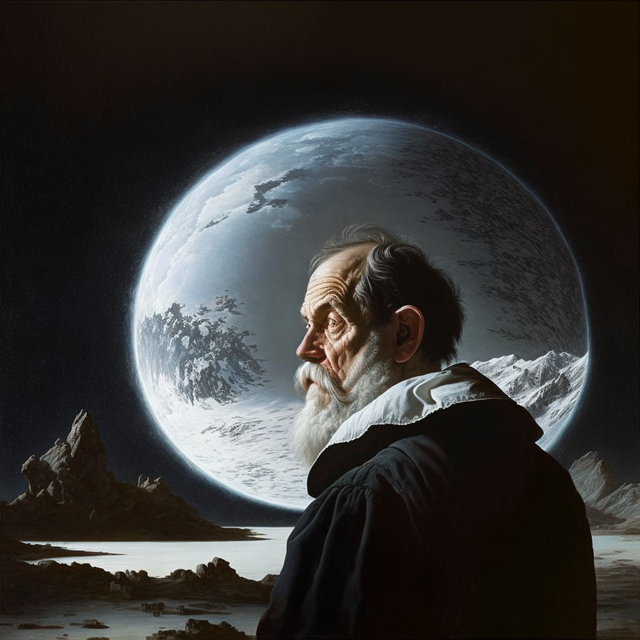
Galileo Galilei
Galileo Galilei was an Italian astronomer, mathematician, physicist, and philosopher who lived from 1564 to 1642. He is considered one of the most important figures in the history of science and is known for his many contributions to the scientific revolution of the 16th and 17th centuries.
Galileo's most famous contributions to science are his astronomical observations and discoveries. He is known for being the first person to use a telescope to observe the night sky, and for making many important discoveries as a result. He observed and studied the phases of Venus, the four largest moons of Jupiter, and the spots on the sun. He also discovered that the Milky Way is made up of stars and that the moon has mountains and craters. Galileo's discoveries challenged the prevailing Aristotelian view of the universe and laid the foundation for the Copernican heliocentric model of the solar system.
In addition to his astronomical discoveries, Galileo also made important contributions to the field of physics. He is known for his experiments on the laws of motion and gravity. He is credited with the discovery of the law of falling bodies, which states that objects fall at the same rate regardless of their mass. He also developed the concept of the relative motion, which states that the motion of an object is relative to the observer. These discoveries laid the foundation for the development of the laws of motion by Sir Isaac Newton.
Galileo was also a skilled mathematician and made many important contributions to the field. He was one of the first to use mathematical equations to describe physical phenomena, such as the motion of falling objects. He also made important contributions to the field of geometry, developing the concept of the geometric mean and the method of indivisibles.
Galileo's work was not always well-received by the Catholic Church, as it challenged the traditional Aristotelian view of the universe. In 1632, Galileo published his book "Dialogue Concerning the Two Chief World Systems," in which he presented arguments for and against the Copernican heliocentric model of the universe. The book was seen as an attack on the Catholic Church's teachings, and Galileo was put on trial for heresy. He was found guilty and was placed under house arrest for the last nine years of his life.
Despite the controversy surrounding his work, Galileo's contributions to science were significant and had a lasting impact. His use of the telescope to observe the night sky revolutionized astronomy and paved the way for future discoveries. His work in physics laid the foundation for the development of the laws of motion and gravity. And his mathematical contributions had a lasting impact on the field of mathematics. Galileo's work and ideas were a key part of the scientific revolution and continue to shape our understanding of the world today.
Galileo was a true polymath and his work covered a wide range of topics, from astronomical observations to physics and mathematics, making him one of the most important figures of the scientific revolution. He paved the way for many future scientists and continues to be studied and celebrated for his contributions to the field of science.
Subject Contributions
- Philosophy
- Astronomy
- Physics
- Mathematics