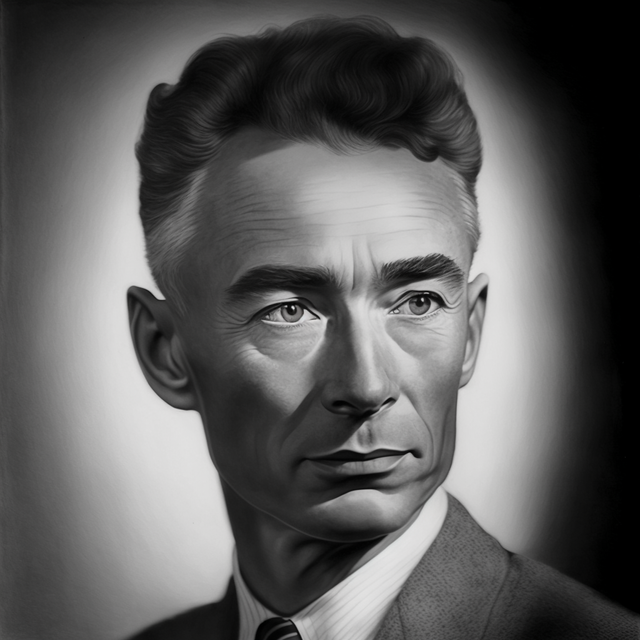
Robert Oppenheimer
Robert Oppenheimer was an American theoretical physicist and professor of physics at the University of California, Berkeley. He is best known for his role as the scientific director of the Manhattan Project, the World War II project that developed the first nuclear weapons, for which he is often referred to as the "father of the atomic bomb".
Oppenheimer was born in New York City on April 22, 1904, to Julius Oppenheimer, a wealthy German textile merchant, and Ella Friedman, a painter. He was raised in an upper-middle-class Jewish family and was educated at the Ethical Culture Fieldston School and the Bronx High School of Science. He then attended Harvard University, where he studied chemistry and physics, and was awarded his bachelor's degree in 1925.
After graduation, Oppenheimer traveled to Europe to study at the University of Göttingen in Germany, where he worked with Nobel laureate Max Born. He then moved to Cambridge University in England, where he worked with J.J. Thomson and Ernest Rutherford. In 1927, he returned to the United States and began graduate studies at the California Institute of Technology (Caltech).
In 1929, Oppenheimer accepted a fellowship at the University of Leiden in the Netherlands, where he studied under the renowned physicist Paul Ehrenfest. He returned to the United States in 1930, and received his Ph.D. in physics from Caltech in 1933.
Oppenheimer's early research focused on the behavior of atoms and molecules, and he made important contributions to the study of quantum mechanics and the theory of electrons. He also worked on the development of the first cyclotron, a type of particle accelerator, at Berkeley.
In 1939, Oppenheimer was recruited by the U.S. government to work on the Manhattan Project, a top-secret project to develop an atomic bomb. He was appointed the project's scientific director and oversaw the development of the bomb at the Los Alamos Laboratory in New Mexico. The first successful test of the bomb was conducted on July 16, 1945, and the bombs were dropped on the Japanese cities of Hiroshima and Nagasaki later that month, leading to Japan's surrender and the end of World War II.
After the war, Oppenheimer continued to work in the field of nuclear physics and became a prominent figure in the development of the hydrogen bomb. However, he also became an outspoken critic of the arms race and the use of nuclear weapons.
In 1953, Oppenheimer's security clearance was revoked by the U.S. government, based on allegations of communist sympathies and security risks. The decision was controversial and Oppenheimer fought the revocation in a highly publicized hearing. He was ultimately denied clearance, and his career and reputation were severely damaged.
Oppenheimer died on February 18, 1967, at the age of 62, from throat cancer. He is widely considered one of the most brilliant and influential scientists of the 20th century and his contributions to the field of physics continue to be highly regarded.
Subject Contributions
- Physics
- Mathematics
- Politics
- Logic