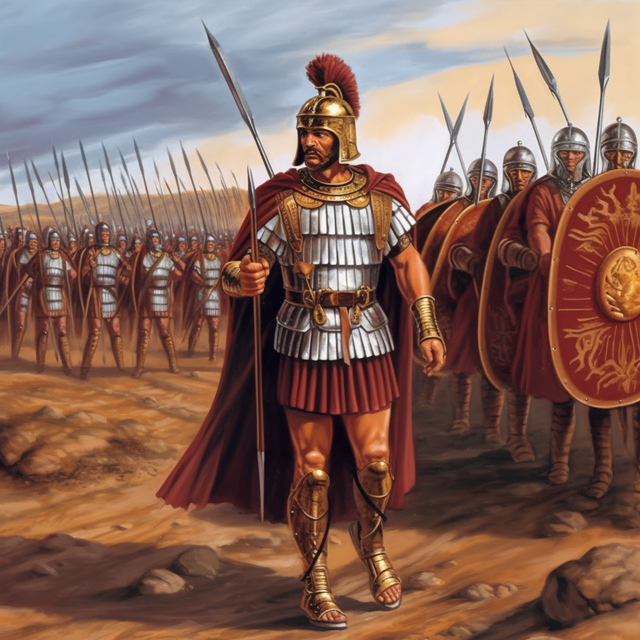
Publius Cornelius Scipio Africanus
Scipio Africanus, also known as Scipio Africanus the Elder, was one of the most brilliant military commanders in Roman history. He was born in 236 BC into a prominent patrician family and came to prominence during the Second Punic War against Carthage.
Scipio's early years were spent in the shadow of his father, who had been a consul and a hero of the First Punic War. As a young man, Scipio served in the Roman army in Spain, where he gained valuable military experience and demonstrated his leadership abilities. In 210 BC, at the age of 26, he was elected consul and given command of the Roman army in Spain.
Scipio's campaign in Spain was a resounding success. He defeated the Carthaginian armies in a series of battles and captured the important city of Carthago Nova. His victory in Spain secured Rome's dominance in the western Mediterranean and made Scipio a national hero.
In 204 BC, Scipio was appointed to lead the Roman forces in North Africa against the great Carthaginian general, Hannibal. The war had been raging for over a decade, and the Roman army had suffered a series of humiliating defeats at the hands of Hannibal. Scipio realized that the only way to defeat Hannibal was to take the war to Carthage itself.
Scipio's invasion of North Africa was a risky move, but it paid off. He won a series of decisive battles against the Carthaginian forces, including a spectacular victory at the Battle of Zama in 202 BC. This battle is considered one of the greatest military victories in Roman history and marked the end of the Second Punic War.
After the war, Scipio returned to Rome a hero. He was awarded the title of Africanus, in honor of his victory in North Africa, and was elected consul for a second time. Scipio used his influence to push for reforms that would strengthen the Roman Republic and help prevent future wars.
Scipio's military achievements were remarkable, but his legacy extends beyond his victories on the battlefield. He was a statesman as well as a warrior, and he understood the importance of diplomacy in maintaining peace. He negotiated a treaty with the Numidian king, Masinissa, that helped to secure Rome's position in North Africa. He also established friendly relations with the Greeks and other peoples of the eastern Mediterranean.
Scipio's influence on Roman society was profound. He was a patron of the arts and sciences, and he encouraged the study of Greek literature and philosophy. He was also a devout follower of the Roman religion, and he played an important role in promoting the cult of Jupiter Optimus Maximus, the chief deity of the Roman pantheon.
Despite his many accomplishments, Scipio's life was not without controversy. He was accused of corruption and immorality by his political enemies, and there were rumors that he had engaged in secret negotiations with the Carthaginians during the Second Punic War. These accusations were never proven, but they tarnished Scipio's reputation and may have contributed to his decision to withdraw from public life in his later years.
Scipio's military achievements were impressive, but it was his statesmanship and leadership that set him apart. He was a visionary who understood the importance of diplomacy and the need for reform in the Roman Republic. His legacy continues to inspire us today, and his story reminds us of the power of perseverance and determination in the face of adversity.
Subject Contributions
- Mathematics
- Political Philosophy
- Logic
- Literature
- History
- Philosophy